Showing posts with label fovant badges. Show all posts

Monday, 22 December 2014

New badge for Fovant

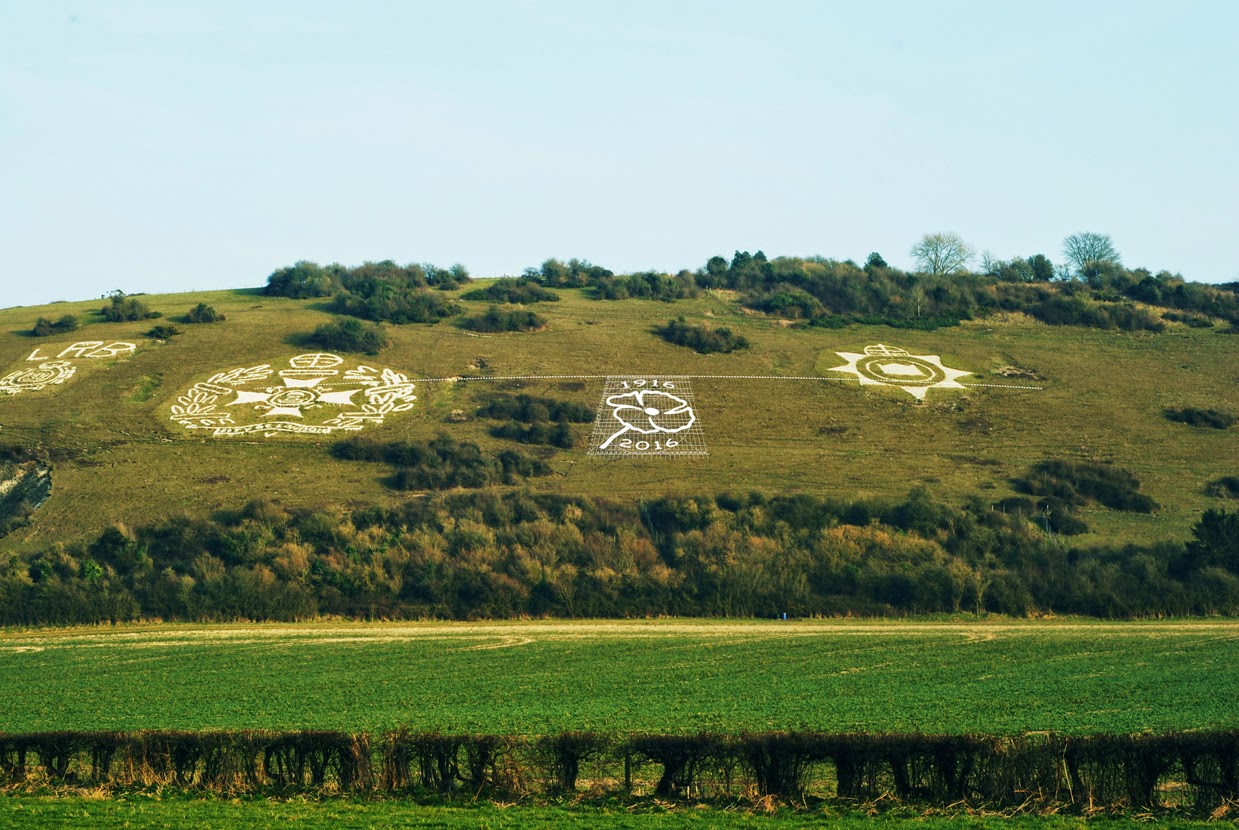
The Fovant Badges Society and the First World War Centenary – Centenary Badge to be constructed in 2016

The Fovant Badges Society is the local charity that maintains the Fovant Badges National War Memorial. Five of the surviving eight badges on Fovant Down date from 1916 and were constructed by soldiers stationed at Fovant. The advent of the Centenary of World War One has presented the Trustees of the Society with an opportunity to widen the appeal of the Badges Memorial to a wider and younger audience, thus further securing their long term future.

The Trustees of the Society have decided that this most important centenary can best be marked by the building of a new badge on the hillside to join the other eight. The design will be a poppy of 25m diameter with “1916” and “2016” legends. As far as possible the new badge will use construction techniques that would have been available familiar to the soldiers stationed in the area during World War One. The Society is delighted to announce that English Heritage have just granted the society Scheduled Monument Consent for the Centenary Badge. This is a very significant milestone in the project.


Many options were considered by the Trustees before deciding on the poppy design.
The design was chosen because it directly relates to the poppies that grew in “Flanders Fields” where so many soldiers fought and died in WW1. The wearing of the Royal British Legion “Poppy” is the way that we all remember the sacrifices made by British and Commonwealth service men and women since WW1. It is an image that we can all relate to and understand and we are sure that those soldiers stationed at Fovant 100 years ago would have understood and applauded our desire to follow their example and build a chalk “badge” on Fovant Down.

The society will now move to the next stage in this project and will start fundraising efforts.

For further details please contact:
Richard Bullard – 01722 714782, email: Fovantbadges1@outlook.com
Website is http://www.fovantbadges.com/

Wednesday, 11 June 2014

Wylye Valley celebrates 100 years with local history society


The AONB was originally approached by this small local history society, a sub-group of the very active Codford Local History Society, as they wanted to work with the AONB to produce materials that helped document the military activity between Longbridge Deverill and Codford circa 1914-1919. 


The Study

Several very good books had already been published about the Codford area at the time of the First World War. The history group wanted to commemorate the centenary of the start of the Great War in 1914, 100 years on in the summer of 2014 and the sudden dramatic social and practical effects this had on the local Wiltshire population.

The arrival of the overwhelming numbers of troops signaled the end of the old peacetime era. Turmoil hit the villages which never resumed their original social posture. This study seeks to reveal the changes that occurred, to uncover the views of the local people, and of the soldiers towards them. All ages are involved and the group has been very active in the support of local school children which will all culminate with a great calendar of events over the period of the Centenary in 2014.

Think about it

The Wiltshire villages involved are: Longbridge Deverill, Sutton Veny, Heytesbury, Corton, Boyton, Upton Lovell and Codford. Many farm horses were requisitioned at harvest time (and young soldiers helped); local men flocked to the colours and left the area; tents were all very fine till the rains came (no floors and floods and mud were the norm). How to organise the feeding (no spoons!), accommodation (not enough tents), medical care (one village doctor), command (scarcely any officers or NCOs), training and a thousand other aspects: this is our topic. We need your help.

Wylye Valley Map extractYour part in it

Please explore their web site which showcases a host of activities occurring in the area during July and August. The showcase will be the weekend of activities on July 26th and 27th where the interpretive display map of 8m x 3m will be on display along with other activities such as a short film, photographs and models. www.wylyevalley1914.org.uk  

How did we go about it?

We are proud to have supported this local group both through SDF funding and through our GIS wizard Harry Bell's expertise who compiled the digitised map along with the help of Emma at Wyvern Heritage, and Richard Broadway.

After relevant 1920's black and white OS digital map tiles were purchased, work began on digitising the location of the camps and associated huts, tents, military hospitals and railways.

In addition to the many hours spent digitising information from paper copies, it was decided that the OS backdrop was a bit bland, and the rivers, roads and woodlands/marsh features were painstakingly coloured in as well.

An extract of the final poster is below. The map info layers are available to anyone upon request (excluding the OS maps). It is interesting to switch from the map in Mapinfo into Google Earth as it really brings the information alive, and if overlaid onto aerial photography some of the features on the ground such as ditches and roads can still be seen.

The final display map is printed on cloth and includes photographs and commentary that demonstrates how the military used this area as a military base with hospitals and training grounds covering iro 20miles square.


Wednesday, 5 February 2014

Discover Nadder Website Launched

www.discovernadder.org.uk
Discover Nadder, a new website promoting tourism and businesses in the Nadder Valley, is now live; ideal if you are running a tourism related business across the Cranborne Chase AONB.

The website was put together by Cranborne Chase Area of Outstanding Natural Beauty, working in partnership with partners and local businesses, as part of a Sustainable Rural Tourism Pilot Project to help improve the visitor economy of the area. 


We hope the site will promote the Cranborne Chase AONB as an outstanding destination for people to visit benefiting businesses like pubs, shops and accommodation providers, and provide ready made experiences for visitors who are interested in the outdoors and wish to discover more about the history and wildlife of the area.

The Nadder Valley stretches from Wilton to Shaftesbury and includes part of Wiltshire and Dorset. It is a beautiful and largely undiscovered area with over 30 picturesque villages dotted along the River Nadder. Highlights include:


  • Tisbury, the largest of the Nadder Valley villages; at its heart is a friendly and thriving High Street as well as a convenient railway station for day-trippers wishing to come from Salisbury.
  • Postcard pretty historic villages like East Knoyle, birthplace of architect Sir Christopher Wren whose masterpiece was St. Paul’s Cathedral in London.
  • The wild open expanses and tranquillity of the chalk downs.
  • Great historic estates of Dinton Park, Fonthill and Wardour.
  • Ancient churches, Iron Age Hill Forts and ancient burial grounds.
  • Major attractions like Old Wardour Castle near Tisbury, one of the Nadder Valley’s best kept secrets.


The AONB and South West Wiltshire Area Board have recently committed funding to create a similar website for the Chalke Valley. If you would like to be involved in this process or have any comments/suggestions on ‘Discover Nadder’ then please contact Steve Harris, Community Area Manager for South West Wiltshire Area Board. There will be an evening on Thursday 27th February when you can drop in to learn more about this exciting venture at the Crown Alvesdiston from 4 - 7pm. 


Wednesday, 22 January 2014

Fovant Badges Society – World War One Centenary Project


Fovant Badges Wiltshire
 
The Fovant Badges Society is the charity responsible for the maintenance of the badges cut into the hillside overlooking Fovant. The first badge was constructed in 1916 by soldiers stationed at Fovant in World War One. They are Scheduled Monuments and War Memorials. Five of the surviving badges date from World War One, two from just after World War Two and the last was constructed in 1970. Annual maintenance costs for the Society amount to around £30,000.

The World War One Centenary

The Centenary has created huge public and media interest in World War One. The Trustees of The Society cannot afford to miss this absolutely unique opportunity to raise awareness of the badges.

The objectives of the Fovant Badges Society can be summarised as:

  • To ensure that the Fovant Badges can be enjoyed by future generations and
  • To educate members of the public about the Fovant Badges
The Society’s plans for the World War One are a two stage Education Project that is designed to safeguard the future of the badges by generating new interest in them amongst a wider, and younger, audience.

 Education Project – Part 1

We are pleased to announce that the Society has received a grant of £8,400 from the Heritage Lottery Fund’s First World War: then and now programme for the first part of our education programme. The grant will help the Society to widen the appeal of the badges by re-imagining them as a window onto Britain’s history in the C20th. The project will deliver:

  1. Interactive material (an education pack) describing the history of Fovant First World War Army Camp[1] and its impact on the Wiltshire village of Fovant and the subsequent history of the badges. The intention is that it will be made available to schools to better inform the Centenary Programme. This part of the project will be completed by September 2014.
  2. Working with the University of Southampton, a one day symposium on the subject of War, Landscape and Memory in the Twentieth Century will take place on 7 May 2014 at the Salisbury and South Wiltshire Museum. The target audience is the general public, academics and 6th form students.
  3. In order for the Education Project to have a lasting impact the Society’s website will be updated and expanded so that the results of the project can be made available to all. Completion will be before December 2014. The public will be encouraged to add family recollections of WW1 to the website.
  4. In the autumn/winter of 2014/15, a series of public feedback sessions about the project discoveries will be arranged for local communities.

Education Project - Part 2

The second part of the Education Project builds on the schools project outlined above. Its purpose is to involve local schools and communities in a direct way with the badges. In outline this will involve:

  1. The appointment of an Education Officer from 2015 through to 2018. This will be a part time post, probably for 8 days per month.

    1. The Education Officer will be available to schools and local groups to provide greater insight into the material included in the education pack and will encourage groups to visit Fovant and the badges.
    2. The Education Officer and Trustees of the Society will provide liaison and guidance for those school students and other groups that wish to visit Fovant and the badges.
  2. Perhaps the most powerful element of the Education Project is the construction of a new badge in 2016. Whilst this will be project managed by The Fovant Badges Society and its contractor, local schools and the community of Fovant will be encouraged to volunteer and assist in its construction, within H&S guidelines, during which:

    1. We will test some of the theories and myths surrounding the construction of the badges in 1916-18 e.g. how was the design transcribed on to the hillside? Could signal flags and other WW1 communications be used to make design adjustments? And crucially could you slide down the hillside on a spade and/or a shovel?
    2. During construction we propose filming the process so that we will have a permanent record of the processes involved.
    3. The construction of the new badge provides a very real opportunity for re-enacting and recording some of the tales surrounding the badges and the rivalries between the various regiments stationed in the area that were expressed by building ever larger badges. Why, for example, were some of them re-built only months after completion?
    4. Most importantly, the involvement of many schools and members of the local community in the construction of the Centenary Badge will have countless benefits to the participants and the Society by re-invigorating interest in the badges
In conclusion, building a new badge will also enable all of us to salute those soldiers back in 1916 that built the first badges in a way that would make perfect sense to them.

The Centenary Badge will firstly be dedicated to all of the World War One badges and their creators. A new engraved stainless steel depiction of the downs and all of the badges will placed in the A30 lay-by for the enlightenment of our visitors.

Secondly, the Centenary Badge will be dedicated to the sacrifices made by all British and Commonwealth Service Men and Women since 1945 and to those currently serving. For this reason, the design of the badge will be based on The Royal British Legion Poppy.

An application to the Heritage Lottery Fund for this part of the project is in progress.
Richard Bullard - PR and Newsletter Editor, Fovant Badges Society


[1] The Fovant Badges Society would like to thank members of The Fovant History Interest Group for their continued help in this project.