Showing posts with label farming. Show all posts
Showing posts with label farming. Show all posts
Thursday, 20 February 2014
Thursday, 6 February 2014
Help secure funding for rural communities
We need your help!
The recent 5 year RDPE (Rural Development Programme for England) of which the Sowing SEEDS Local Action Group (LAG) funding was part, has now ended. A number of projects in the AONB benefited from this funding including Hindon Village Shop, Semley Shop, Chalke Valley Community Hub, Mere and Tisbury Chambers of Trade, Stourhead Kindling, Kingston Lacey Glasshouse project and the AONB Sustainable Tourism Project - Discover Nadder.
Every LAG in the UK is now in a period of transition (2014) where we have the opportunity to develop a bid for future funding from the next RDPE which is expected to start in January 2015. There is no guarantee of further funding! We need your help to secure funding to support new projects from 2015 to 2020.
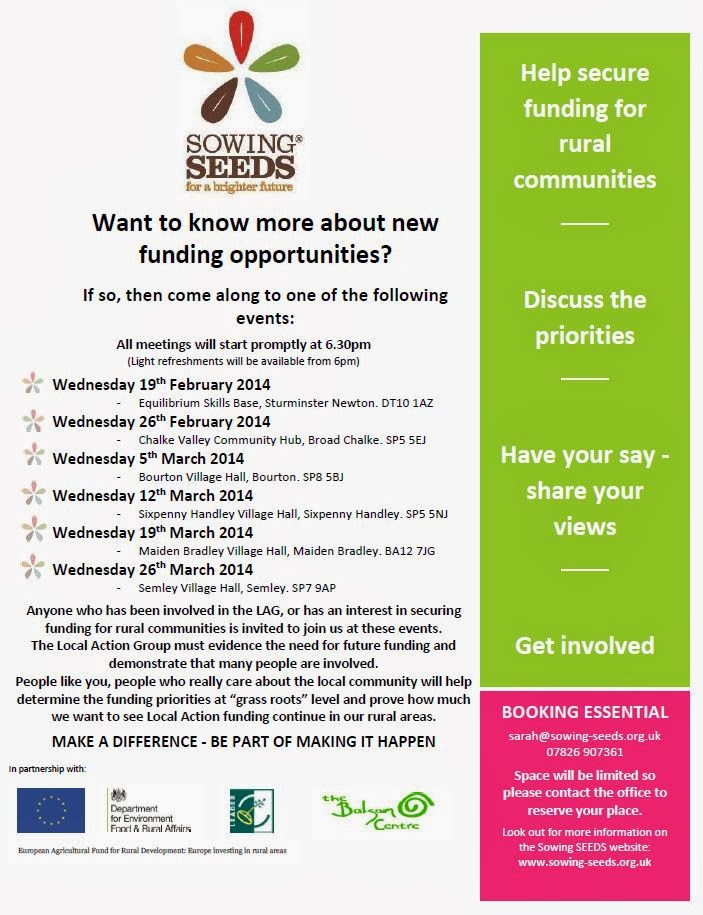
The photo below shows when and where forthcoming meetings will be held. We really do need to show that many, many people are involved in Local Action and most importantly that we want it to continue into the next programme period. This is your chance to say what the priorities are for your area and to put forward project suggestions.
Please forward to your friends, colleagues and contacts and encourage them to come along and support the LAG.
We very much appreciate your support in helping us to secure these vital funds and we look forward to seeing you at one of the upcoming meetings
The recent 5 year RDPE (Rural Development Programme for England) of which the Sowing SEEDS Local Action Group (LAG) funding was part, has now ended. A number of projects in the AONB benefited from this funding including Hindon Village Shop, Semley Shop, Chalke Valley Community Hub, Mere and Tisbury Chambers of Trade, Stourhead Kindling, Kingston Lacey Glasshouse project and the AONB Sustainable Tourism Project - Discover Nadder.
Every LAG in the UK is now in a period of transition (2014) where we have the opportunity to develop a bid for future funding from the next RDPE which is expected to start in January 2015. There is no guarantee of further funding! We need your help to secure funding to support new projects from 2015 to 2020.
The photo below shows when and where forthcoming meetings will be held. We really do need to show that many, many people are involved in Local Action and most importantly that we want it to continue into the next programme period. This is your chance to say what the priorities are for your area and to put forward project suggestions.
Please forward to your friends, colleagues and contacts and encourage them to come along and support the LAG.
We very much appreciate your support in helping us to secure these vital funds and we look forward to seeing you at one of the upcoming meetings


Wednesday, 11 December 2013
HELP US ENSURE FUTURE FUNDING FOR AONB PROJECTS
The AONB and the Community Partnership
Executive of North Dorset (CPEND) jointly prepared the ‘Sowing SEEDS’ bid to Rural
Development Programme for England (RDPE)
in 2008. It was developed to support innovative activities and projects by
rural communities, businesses (including farmers, growers and foresters) and
community organisations within the area.
This funding was the first of its kind to
cover the entire AONB area and offered new prospects to local communities of
all ages, with innovative project ideas.

Between 2009 and 2013, the Local Action Group (LAG),
made up of representatives from the local community, decided which community
based initiatives or projects received funding from ‘Sowing SEEDS’. The contribution that the
Sowing SEEDS LAG has made to the rural community has been significant. In total
it has supported 35 initiatives and awarded grants worth over £1.28 million to
grassroots focused, small-scale, innovative projects , generating an impressive
range of benefits for the area.
Case Studies
A number of
individual case studies which reflect the diversity and range of the projects
the LAG has supported throughout this programme period will shortly be available
on the Sowing SEEDS website, please visit: http://www.sowing-seeds.org.uk/projects.html
Successful Projects
The following
projects received funding through Sowing SEEDS.
Those highlighted in bold are within the AONB. These come to a total of just
under £500,000 but each project will have levered in significant amounts of
additional match funding. Many of the other projects directly and indirectly
benefit the AONB communities and environment.
£19,231.00
|
|
Blackmore Vale Butchery
|
£8,750.00
|
Shaftesbury Film Unit
|
£8,000.00
|
£5,938.00
|
|
Blandford Allotments - Machinery Ring
|
£9,996.00
|
Feasibility Study, Training Unit
|
£10,000.00
|
CPEND Broadband
|
£9,500.00
|
Motcombe Community Shop
|
£29,556.00
|
Future Roots
|
£128,600.00
|
Food Mill Feasibility Study
|
£9,350.00
|
£30,914.00
|
|
Let's go
H20
|
£9,200.00
|
£4,800.00
|
|
Mere
Chambers
|
£8,546.00
|
Wimborne BID
|
£10,000.00
|
Countryside
Centre Phase 1
|
£6,378.50
|
Henry's Buttons
|
£10,000.00
|
Economic Spine
|
£9,950.00
|
Tisbury
Chambers
|
£8,546.00
|
Leisure
Credits
|
£113,525.68
|
Rural DORMEN
|
£22,500.00
|
Lordsmead Mill Micro Hydro
|
£34,347.55
|
Peggs Farm Micro Hydro
|
£21,807.00
|
Benjafield Farm Micro Hydro
|
£31,213.00
|
Employability Skills Base
|
£146,827.00
|
Semley
Shop
|
£49,548.50
|
Driving Rural Business
|
£62,221.00
|
Sustainable
Tourism
|
£58,285.00
|
Trailway Wood Fuels retort system
|
£11,654.40
|
CHAT Hub
|
£198,369.00
|
£91,734.00
|
|
Bangers
& Bacon
|
£10,000.00
|
Stourhead
Kindling
|
£9,960.00
|
Blandford Car Club
|
£9,266.00
|
£38,345.00
|
The
next Rural Development Programme
The next Rural
Development Programme is anticipated to start during 2015 and will run until
2020. The Sowing
SEEDS Local Action Group has been awarded funding to cover the period of
transition between the current and future Rural Development Programmes
during 2014. The funding
will allow the Sowing SEEDS programme staff to begin a thorough participatory
consultation period with communities across the whole LAG area. The LAG will
be seeking views from local communities and businesses to inform the content of
the new strategy. Activity to gather these views will include:
- A series of public consultation meetings
- Recruitment of new LAG members and formation of a new LAG Executive
Committee
- Gathering background information about the Sowing SEEDS LAG area
- Seeking views from previously funded LEADER projects
The information gathered from these meetings will
inform the preparation of a new Local Development Strategy (LDS). This strategy
will set development priorities for the next funding period.
How you can help ensure that local action
continues in this area:
1. Complete a very short on-line survey - The future success of Local Action relies entirely on the local community. Your input is needed to help shape the future of Local Action in this area, so even if you feel you have had little or nothing to do with this programme your response is very much appreciated.
All
completed surveys will be anonymous and a summary of the results will be used
to help prepare the final programme evaluation. Please follow the link below:
- Project
ideas – Although currently
there isn’t any funding available for the remainder of this programme
period, we would still like to hear from you if you have a project idea
that you would like to discuss. We are keeping a list of prospective
projects so we can contact you when we know when future funding becomes
available. Please contact the Sowing SEEDS office if you would like to be
added to this list and receive further news of funding opportunities.
- Take part in one of the of
Consultation Workshops - The current LAG have organised six meetings that
will take place across the LAG area throughout February and March 2014.
The workshops will be an opportunity to share your views, opinions and
ideas about the future of LAG activity in the area. As always light
refreshments will be served on arrival.
Schedule of meetings:
·
Wednesday 19th February 2014. 6pm - Sturminster Newton
·
Wednesday 26th February 2014. 6pm - Broad Chalke
·
Wednesday 5th March 2014. 6pm - Bourton
·
Wednesday 12th March 2014. 6pm - Sixpenny Handley
·
Wednesday 19th March 2014. 6pm - Maiden Bradley
·
Wednesday 26th March 2014. 6pm – Semley
|
- For up-to-date information about the Rural Development Programme for England (RDPE) visit: http://rdpenetwork.defra.gov.uk/
Please
contact Sarah Dyke-Bracher – Programme Manager on 07826 907361 for further
details
Wednesday, 4 September 2013
Packs of Free Trees
The Woodland Trust is offering
community groups, youth groups and schools the chance to apply for packs of free
trees for delivery in November 2013 and is accepting applications until 13
September. The packs come in three sizes – 30 saplings, 105 saplings and 420
saplings in various themes (hedge, copse, wildlife, wild harvest, year-round
colour, future firewood and wetland).
Wednesday, 10 April 2013
Are You a Dog Owner? Do You Like Walking in the Countryside? If so read on…

As
the weather improves, dog walkers in the Cranborne Chase and West Wiltshire
Downs AONB are being asked to keep their pets on short leads to protect
young animals and birds during the breeding season.
Sheep with
lambs, ground-nesting birds like skylark and lapwing, and wild creatures such
as hares, are easily scared by dogs running free or on extended leads.
Farmland
Bird Adviser Tracy Adams said: “Spring and early summer are critical times
especially for breeding birds. They need to be undisturbed to give them the
best chance of laying a good number of eggs and raising as many chicks as they
can, particularly after last year’s disastrous breeding season”
“Birds
like lapwing and skylark used to be a common sight in the countryside but they
are in decline nationally. We aim to reverse this trend through the South West
Farmland Bird Initiative and are working with farmers to provide year-round
food and breeding areas across the AONB. This includes cultivated land as well
as pasture.”
“Dog-walkers
can help protect the birds by keeping their dogs on a short lead on open farmland.
I have a big, lively dog and know how nice it is to let him off for a run in a
large field but this is precisely the place where lapwing and skylark could be
nesting. Unfortunately, many dogs particularly working dogs like spaniels, are
programmed to sniff out birds and can have devastating effects on the bird’s
breeding success. Disturbing birds whilst they are sitting on eggs can lead to
the eggs becoming chilled so the chicks inside die. Repeated disturbance can
prevent future nesting attempts”

Dog owners
have a responsibility under the Countryside and Rights of Way (CROW) Act to
keep their dogs on a lead around wildlife between March 1 and July 31 and at
any time near farm animals. Owners of land who grant permissive access, often
funded under conservation schemes, can legally request that dogs be kept
leashed; look out for signs on the entry points. These areas have often been
created for wildlife and funded by the taxpayer.
To stay
safe and help protect wildlife and farm animals:
•Never let
a dog approach or chase wildlife and farm animals - your dog can get
kicked, trampled or lost; it could be shot for chasing livestock and you could
be prosecuted.
•If cattle
turn on your dog, unclip the lead - a dog can usually look after itself, don’t
risk getting hurt by trying to protect it. Get out of the field as quickly as
possible, then call your dog as soon as you are out of danger.
To report
incidents involving dogs on farmland please contact the police on 101. For more
information on the South West Farmland Bird Initiative contact Tracy Adams
01725 517417 tracyadams@cranbornechase.org.uk
Friday, 8 March 2013
Meeting with Natural England
Really positive feedback from yesterdays meeting with Natural England's Executive Director Jim Smyllie. The conversation was a really useful one in the morning whilst the visits in the afternoon could not have gone better. Discussing landscape issues, opportunities and challenges for the next environment scheme for farmers and the opportunities for farmer collaboration.


Wednesday, 30 January 2013
LWEC new funding for tree health
The Living With
Environmental Change (LWEC) Partnership will shortly be announcing on its
website (www.lwec.org.uk) a new initiative to fund research
into tree pests and pathogens, and associated plant biosecurity.
At least £6.5M
will be available for research projects. Trees make a huge impact on our rural
and urban landscapes and contribute to a vital part of our heritage, rural
economy and well-being. In the last few years, several new pests and pathogens
have emerged as significant risks to the UK’s woodlands, commercial forests and
urban trees. The outbreak of ash dieback at the end of 2012 illustrates how
rapidly new diseases can take hold, and the scale of the threat they can pose to
trees. This new initiative will require collaboration between specialists in
tree or forest research, and leading-edge scientists from the wider natural,
biological, social, economic or other relevant research communities who have
other, broader expertise that could help to advance our knowledge about tree
health and disease.
There will be a Town
Meeting in London on 14 February where LWEC will be providing more
information. This meeting will also provide an opportunity for researchers who
do not currently work on tree health but who have expertise which may be
relevant to this area to meet potential collaborative partners, and learn more
about current research in this area.
The Town Meeting is free of charge to
attend but please email tree.health@bbsrc.ac.uk to reserve a
place.
Monday, 21 January 2013
New book on governance of livestock disease out soon
A new book from
Relu’s Governance
of Livestock Disease team is being published by Routledge. The
Regulation of Animal Health and Welfare: Science, Law and Policy by John
McEldowney, Graham Medley and Wyn Grant with Jonathan Cave, Laura
Green, Matthew Keeling, Justin Greaves, David Carslake, Habtu Weldegebriel and
Amy Kilbride is due out in the spring. Details and pre ordering are available
via the publisher’s
website.
Friday, 7 December 2012
Young Farmers launch campaign to save lives on rural roads
Young Farmers, supported by NFU Mutual, are launching a
national campaign today to reduce the number of young driver deaths on rural
roads, during Road Safety Week. The Drive it Home campaign is being launched at
the ProDrive Centre in Warwickshire where young racing drivers from Drive
Doctors are taking young farmers out on a wet grip activity to give them a
greater understanding of the risks of driving on challenging road surfaces such
as mud, snow and ice and how to reduce these risks. Statistics show that rural
young drivers are 37% more likely to have an injury collision on a rural road
than those who live in an urban area (Road Safety Analysis 2012). In the last
two weeks, the Federation is aware of two of its members who were killed in a
rural road traffic incident.
For more information, please visit
the National Federation Young Farmers’ Club website http://www.nfyfc.org.uk/
Monday, 6 August 2012
Ever increasing circles
Summer is now upon us and as you travel through the Wiltshire countryside, some strange patterns may well catch your eye as you pass by. Why does Wiltshire have so many crop circles? It may be coincidence but the geography and geology of the area appears to increase the chances of them appearing. Data suggests that in the UK, 71% of crop circles are found on chalk land and 87% are found to be above aquifers. Also agriculturally Wiltshire is ideally suited to grow cereal crops and oilseed rape-which are the most favoured mediums of the crop circle artistes, whoever they may be.
Crop circles are classed as recent phenomenon; they have only started to come to notice in the last 25 years or so. In fact, these oddities have been reported in at least 54 countries. From America to Africa, there have been many accounts over the centuries. These weird geometric shapes have not only appeared in crops as the name would suggest, but also in snow, grass, sand and reeds. In almost all cases, the shape has been circular and usually a very basic structure.
During the 1990s crop circle activity increased substantially and the designs became more elaborate. Up until now, the shapes had been explained away by many due to their simplicity. The first square to appear within a crop formation was recorded at Winterbourne Bassett in 1998. This particular pattern was believed to represent the cub octahedron. Since then there have been images of aliens, Celtic symbols and even a TV programme’s logo.
This is taken from http://www.wshc.eu/blog.html
Wednesday, 11 July 2012
Milk cheaper than bottle water!
As you may have seen in the news recently, dairy farmers are planning to protest today in London about the price they are paid for their milk. This is a reaction to the recent price cuts by 4 major milk processors of up to 2p/l in the price the farmers receive for their product. This might not sound much but consider an average dairy farm with 120 cows each producing 10,000 litres of milk a year....
Unbelievably farmers don't have written contracts with agreed prices in for their product as you would expect, so there is not a lot they can do when the price is dropped - they can't go on strike and stop production because cows produce milk for about 300 out of 365 days a year and need milking daily and they can't turn round and offer their product to someone else at short notice. (This is common to other farmers too who supply supermarkets/processors with fruit and veg; no set written contracts with prices and conditions changing at will - hence the call for a grocery adjudicator)
Currently the cost of milk production is about 30p/litre but the price farmers are currently getting paid is around 25p litre. What do you pay? Do you know how much a litre of milk is? Less that you would pay for some bottled water. Its doesn't take a mathematician to realise that a business cannot sustain this sort of loss making operation and this latest price cut will only accelerate the number of farmers leaving the dairy industry.
So what? This decline in our dairy industry means that 2 things could happen - we may have to start importing fresh milk; bearing in mind that Britain has gold plated welfare and food protection standards imported milk may not produced to the same standard and how will it keep as long? It may cost more as it has to be tankered across the Channel... Secondly those farmers choosing to stay in milking will be forced down an ever more intensive industrial-scale farming system in an attempt to keep milk production costs below falling prices (although the price to the consumer doesn't seem to fall).
Is that what we want? Would you like to live next to a super dairy with 800 cows kept indoors?
So if you think this is an important issue please take a minute to sign the e-petition asking that farmers be paid a fair price for their milk. i.e. one that covers production costs.
http://epetitions.direct.gov.uk/petitions/6424
New AONB Video
Just put together a 5 min video on the Cranborne Chase & West Wiltshire Downs Area of Outstanding Natural Beauty detailing the landscape features and the work that we do. Please like our Facebook page as we're trying to build our links by clicking on the Facebook logo and get in touch if you'd like more information. Nicky

http://www.facebook.com/ccwwdaonb
http://www.facebook.com/ccwwdaonb
Wednesday, 9 May 2012
Funding for educational access through the Higher Level Stewardship scheme

Farmers in England England
The rate of grant available will depend on the work being undertaken. For example access furniture has set grant rates, educational access facilities such as classrooms can receive up to 80 percent of the total cost subject to a ceiling of £50,000 for classroom facilities and £25,000 for toilets/washing facilities. CEVAS training can be paid in full. Farmers in HLS who can demonstrate the potential for their farms to host high quality educational visits for school children or care farming clients should contact their local Natural England Land Management Adviser by 30 June 2012 to apply for the funding. See www.naturalengland.org.uk
Subscribe to:
Posts (Atom)